Photo courtesy of Susannah LeMarquand
Fall Dance Happening Opens on Campus
Share

Photo courtesy of Susannah LeMarquand
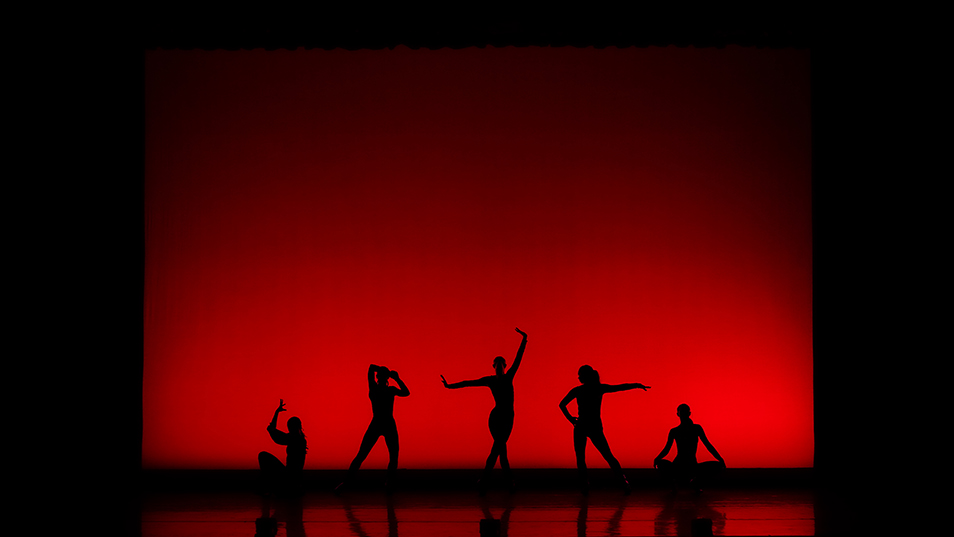
Last night in Falk Theatre, after the lights went down, the annual Fall Dance Happening opened with the first set of dancers performing sharp, staccato movements in a military-style routine. Then, another dancer weaved through the scene, disrupting the meticulous motions.
“That one dancer represents those events or people that you meet in your life that make you question what your path is, and the dancers that are moving linearly across the stage represent a more direct path,” said Abby Jeffries ’28, who choreographed the opening piece.
This semester, the Fall Dance Happening features work choreographed by nine students. The show, free and open to the public, will run again tonight and tomorrow at 8 p.m. in Falk Theatre on campus.
Jeffries’ piece continued with the dancers displaying the ripple effect that happens when a person or event changes the course of one’s life. They moved in a canon sequence, which is when dancers perform the same movements one after another rather than all at once.
Choreographers cast the dancers, who are comprised of both dance majors and non-majors. Jeffries worked with a cast of 15 dancers, the most of the show, as she wanted to emphasize the impact of the staggered movements. As a double major in communication and dance, she said that her two majors complemented each other, as she felt like she had the proper tools to convey her ideas.
Jeffries performed in two other pieces choreographed by her peers. One, choreographed by Sarah Kaliberda ’27, is about how intrusive thoughts and anxiety can affect relationships, both platonic and romantic.
“We think that we’re protecting ourselves, but we’re actually doing more harm than good when we hold onto past baggage and let that dictate our choices,” Kaliberda elaborated.
This is Kaliberda’s third time choreographing at the University, and she said she is drawn to sharing stories that people can relate to and have experience with.
Choreographers for the Fall Dance Happening dictate all the visuals on the stage, including lighting and costumes. Kaliberda’s piece uses two lighting cues to convey the emotions of the lead dancers: one is a bluish-white to make the dancers and audience feel cold and harsh, while the other is a warm golden yellow.
Throughout the dance, the female lead is trying to escape her intrusive thoughts as she enters a new relationship, and every time she lets them manipulate her, the lighting switches to the icy hue. When she’s working to move past her fears and give the new relationship a chance, the lighting returns to the friendlier, sunshine-y color.
While Jeffries and Kaliberda took inspiration from broad, abstract concepts that allow the audience to create their own interpretations, other choreographers leaned in a more narrative direction.
When Olivia Astbury ’27 took a creative writing class, she penned a murder-mystery involving a husband and wife. As a double major in dance and psychology, she was intrigued by the idea of creating false memories to ignore the biggest regrets in life, and she wanted to explore that idea off the page.
“It’s almost innate the way I incorporate psychology into dance and dance into psychology,” said Astbury.
In the dance, the murderer convinces themselves that they are innocent by creating false memories and suppressing the real ones. Throughout the piece, the killer reckons with their conflicting recollections, supported by an ensemble cast, including a questioner and a jury. The dance ends with the murderer coming to terms with what they did, peeling off black gloves to reveal red ones, symbolizing blood on their hands.
Costume choices also play an important role in the piece choreographed by Hayley Habach ’28, which was a personal exploration of spirituality. In the cast of 12, four members are clothed in black, representing the dark forces in the world; four in white, representing goodness and light; and four in gray, representing the “space between.” Those in gray are seeking purpose and hope, and at the end of the piece, some of them pair off with the dancers in black and white, meaning they’ve chosen either a path of destruction or one of enlightenment. The gray dancers left alone at the end continue searching for truth and peace during their life on Earth.
“No matter what religion anyone in the audience is, at the end of the day, we all go through these ups and downs,” said Habach. “We’re all seeking something.”
Students in the dance program take two choreography classes — one on composition and choreography and one on improvisation — as prerequisites before they can choreograph for the Dance Happenings. They then draft a proposal for their piece and present it to a committee before they get accepted and audition dancers for their cast.
Becca Tow ’27 said that one of the most fun parts about Dance Happening is that, in addition to dancing and choreographing, the students also run the technical production themselves — cuing the lights, running the sound, pulling the curtains — headsets and all. Tow’s piece prominently features colored lighting, using a dreamy pink to symbolize looking at bittersweet memories through rose-colored glasses.
Susannah LeMarquand, director of the dance program, said that since the focus of the major is preparing the students to teach, she encourages them to make their pieces a unique expression of themselves while also setting a foundation for someday teaching in or owning a local dance studio.
“The depth of work that is created by the choreographers will bring out a variety of emotions,” said LeMarquand. “When students are able to collaborate on each choreographer’s artistic process, it gives them a new sense of ownership to their movement and makes each piece all the more engaging to watch.”