Simulation Tests Students’ Global Trade Skills

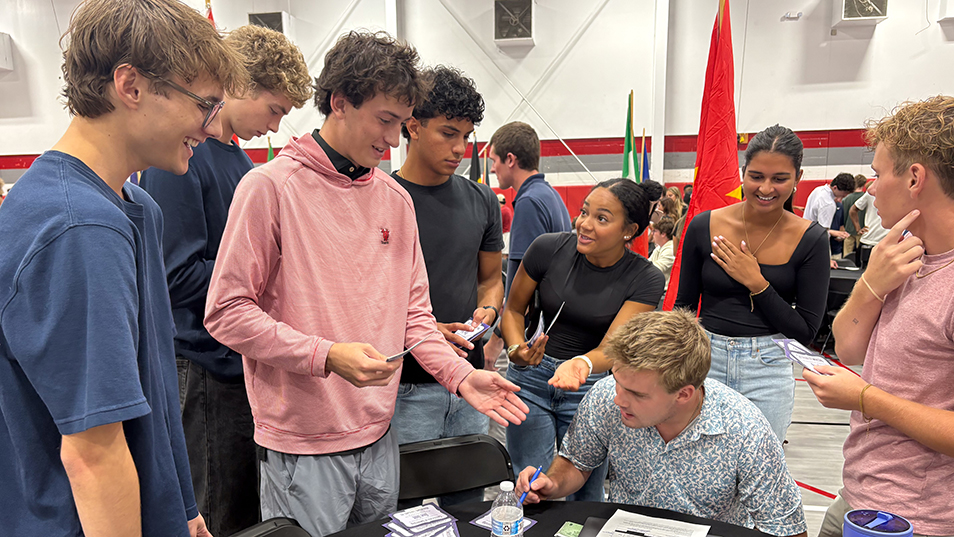
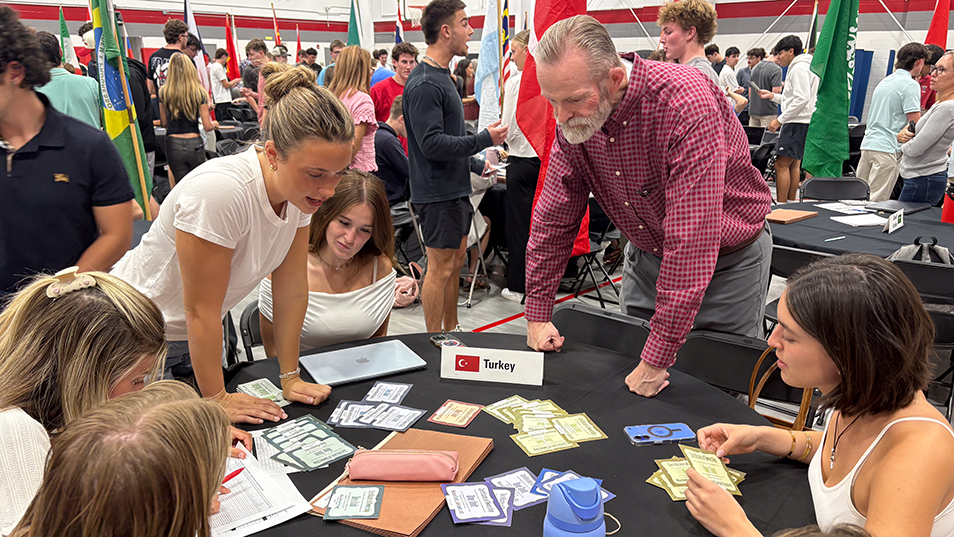
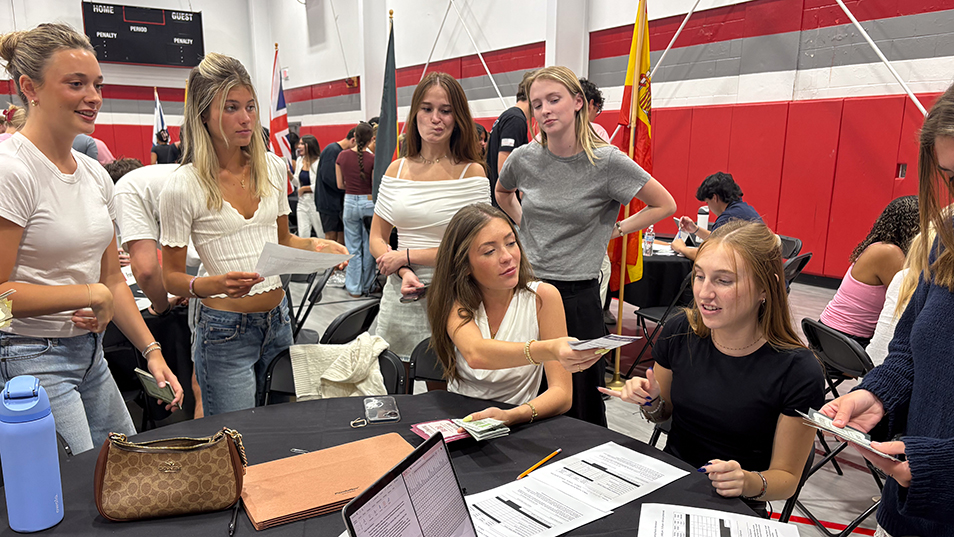
The Business 101 Global Trade Simulation brings together students for a mostly friendly, often chaotic competition. Acting as one of 40 countries, student groups spread out across Cass Gym to export goods and secure imports with just 20 minutes to negotiate. This semester's event took place on Oct. 22. Photos by Jacob Cochran

Earlier this week, the Australian head of state stopped by the office of Professor Britt Shirley for a strategy session on upcoming international trade negotiations.

Then, with a new perspective on import data, he shouldered his backpack and headed to class — as allied health student Danny Brown ’27 — better prepared for the University of Tampa’s Global Trade Simulation on Oct. 22.

Each semester, the Global Trade Simulation brings together the approximately 900 students in Business 101 for a mostly friendly, often chaotic competition. Acting as one of 40 countries — from small economies to superpowers — student groups spread out across Cass Gym to export goods and secure imports with just 20 minutes to negotiate.

Professor Britt Shirley coached four countries at the Global Trading Simulation.

“It’s controlled mayhem some of the time and then just mayhem the rest,” Shirley said. He was there coaching Australia, Turkey, the Netherlands and the Czech Republic, a country he’s taken several student groups to in real life.

As students gathered at a table with their country’s flag, the Netherlands discussed strategy. “We’re going to start small with Germany,” said head of state Maddie Loftus ’27.

“I don’t really know that much about trade,” the psychology major added. “I’m excited to have a hands-on experience that helps me learn more.” 

Maddie Loftus ’27 (center) served as the head of state for the Netherlands.

Experiential learning is also what excites Associate Teaching Professor James Welch. “When you’re teaching global trade in class, it’s really hard to explain until students get into it and start trading,” he said. “When the simulation is over, we hear students saying they wish they could do it again and apply what they learned.”

The simulation is timed to occur after class discussions on international trade. “Students get to see some of the lessons of supply and demand from economics as well as some of the difficulties associated with trading between countries,” Shirley said.

Although the entire simulation takes less than an hour, students pored over real economic data to prepare. They have access to only their import needs before the event, and they get their export list once the event begins. That’s when they figure out that across the simulation there might be more units of food to export than there are of demand or that there are fewer mineral fuels available than are needed across the collected countries.

“I always tell students to have a contingency plan in case the country you targeted doesn’t want to do business with you,” Shirley said.

Fortunately for students, the simulation does not account for tariffs, quotas or embargoes. “Even without those barriers to trade, it’s challenging because you have to find a trade partner you want to work with and who wants to work with you, as well,” Shirley said.

While student teams are ranked at the end of the event, they don’t receive a grade. Teams that do well can earn awards and extra credit.