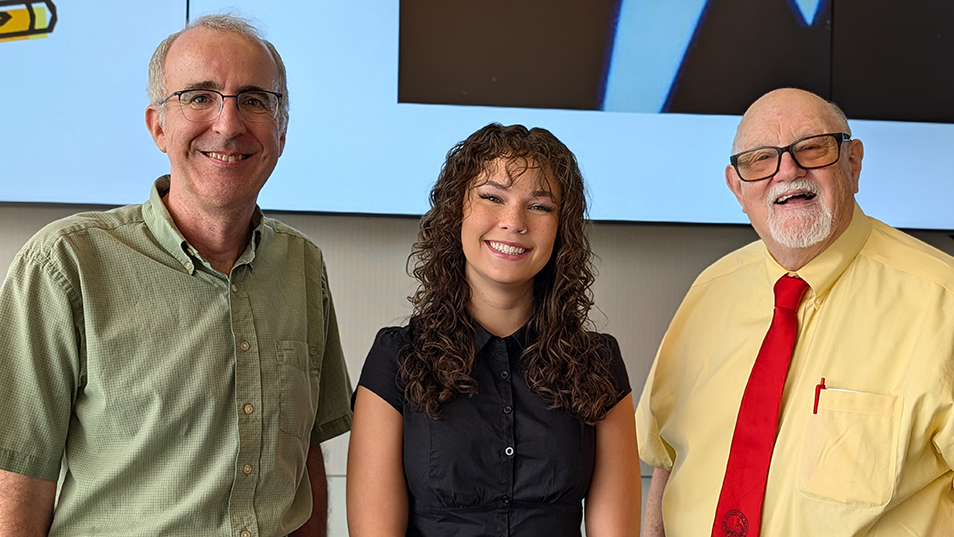
Stephen Blessing, professor of psychology at the University of Tampa, has spent more than 30 years studying how humans learn and developing computer models to help them do it more efficiently. He sees today’s generative AI tools, including ChatGPT, Claude and Gemini, as an extension of that work and has integrated them into his classroom along with his research. Blessing uses AI in courses including Sensation and Perception and is developing new AI assignments for his seminar on thinking.
Blessing holds the Janet R. Matthews Ph.D. Endowed Chair in Psychology, a position in the College of Social Sciences, Education and Mathematics that is funded by UTampa psychology alum Lee Matthews ’67.
This interview has been edited for length and clarity.
Many people are concerned that AI erodes critical thinking. Why bring it into your classes?
“I take the practical view that AI is a tool like any other tool, and there are bad uses of the tool and good uses of a tool. You can use a hammer for good or for ill. I’m not being a Pollyanna. There are definitely bad uses of AI, and when I see students do that, I shake my head and am, like, ‘No.’
I get where some instructors will fall down on that side of things and say, ‘I don’t like AI. I think it’s being used for these bad purposes. So let’s not use it.’ But given that AI is out and about, and students will use it, how can we get them to think about it in a different way and use it more constructively, because there are good uses for AI?”
Is your approach mostly about the fact that students will use AI anyway?
“There’s definitely that side of the coin. The tool’s out. They’re going to use it. Let’s teach them how to use it. But given my history … my graduate training is in applying what we know about how humans learn, and creating computer models of that, and how we can use those computer models to help students learn material more efficiently. I’ve been doing that for 30-plus years now. So here’s just a new computer model that’s more sophisticated than what I was doing in the past, but the idea is still the same. How can we use these new models to help make learning more efficient and robust and better for the student? This is just the extension of what I’ve done for many, many years.”
How do you decide what is an appropriate use of AI for your students?
“Something that I heard really early on whenever generative AI first came into being: One suggestion was you should use it in a course like you would use a teaching assistant.
You wouldn’t ask a teaching assistant, ‘Write my paper.’ That’s obviously inappropriate, but you might … go to their office hours and be like, ‘I’m confused about this particular topic. Can you explain it to me in a different way?’ Awesome, great use of AI. Or, ‘I’m struggling with this assignment. Can you help me put these pieces together and give me an idea of how to get started on this assignment?’ Another good use of a teaching assistant. So I try across all my courses to use it in that way.”
What does that look like in a specific course?
“In my Psych 318 class, which is Sensation and Perception, we talk about all these different concepts that relate to how we experience the world, all these different theories. I try to relate them to how they play out in the real world, not just in the lab. But to have the students make those sorts of connections on their own can be challenging, so I’ve developed an assignment in which I have students start using AI to give them some ideas about how you might be able to connect, say, feature integration theory, which is a particular theory of attention and object recognition, to something meaningful in the real world.”
Students have a conversation with an AI tool to get ideas, Blessing said, using a prompt he provides.
“They use AI, have that conversation with Claude or ChatGPT or Gemini to get some ideas and maybe start to flesh it out. But then once you get the idea, then you have to go off and make it your own.”
Is it working?
“I’ve now done it for a couple of different semesters, and by using the AI, they’re able to make connections that they wouldn’t otherwise see—how these theories play out in the real world in more meaningful ways than I think they would be able to come up with themselves, just due to the nature of the material.”
How do you know students are doing the thinking, and not the AI?
“Obviously, that’s what I’m grading and looking at, and I do have some checks to make sure that they’re doing that work and not the AI. I believe they’re making a good-faith effort to carry out the thinking themselves at the end.”
You teach ethics around AI in academics by example, not just by lecture. How does that work?
“Most faculty members, probably all of us, it’s at least recommended that you have an AI use policy on your syllabus. So I definitely have one. On that first day of class, that’s one of the things I hit strongly, and I give my teaching assistant analogy then. But then I try to model it.”
Blessing said he tells students when he uses AI himself, particularly in drawing models of his work.
“I’m terrible at drawing, and I have this picture in my head of what something should look like on the PowerPoint slide, and in the past, I’ve just suffered through my terrible artistic skills and put something up. But now I find that ChatGPT is really good at making diagrams, and so I can tell ChatGPT roughly what’s in my head, and I get this great chart that I think is pedagogically much better than what I did with my limited skills. So I’ll point out to students, ‘Well, this is how I used AI.’”
How are students responding?
“I find a continuum among them. I know some students probably do take the easy way out. Others are wary. At least last year, I was still having some students be like, ‘Oh no, I don’t want to touch it. I’m afraid for various reasons,’” including worries about being falsely accused of cheating. When he encourages them to try it, Blessing said, the reaction is often positive.
What lessons have you learned about using AI yourself?
“You have to adopt the ‘trust but verify’ mantra. I will catch it in mistakes and say, ‘I don’t think that’s quite right,’ and it’s like, ‘Oh, OK, my bad.’
Trust but verify is something that any user of AI definitely has to have in mind. Something that I stress to students as well: Just because the AI says it’s so doesn’t mean it is so.”
That matters especially in psychology, Blessing said, where citing other people’s work is paramount.