For Katrin-Deniz Natkha ’29, growing up in Berdiansk, a port city on Ukraine’s Azov Sea, meant tourists, rocky beaches and sunshine.
But Natkha was forced to flee just before high school, after Russia invaded her town in February 2022 and food became scarce. An ocean away, at the University of Tampa, she found a piece of hometown familiarity.
The campus atmosphere reminded her of home, but it was the people and undergraduate research opportunities that solidified her decision to leave her family in Europe and come to Florida.
“It was an opportunity, reminding me of home,” she said. It was also a chance to work directly with professors and take advantage of opportunities she would not find as an undergraduate at a larger public university.
“We have great faculty who want to work with students and collaborate on research,” said Natkha, who is majoring in political science and wants to pursue a career in international humanitarian law.
Natkha is one of several Ukrainian students at UTampa studying while their country remains at war, now in its fifth year. Hundreds of thousands of people have died, and at least 3 million Ukrainians are living under Russian occupation.
Driven by the war and Ukrainians’ determination to preserve their identity, Natkha and fellow Ukrainian students are sharing their country’s history and culture with the campus. This semester, Natkha and Varvara Morozova ’29, a sophomore studying international business, founded Spartans Stand With Ukraine to raise awareness of Ukrainian history, culture and the realities of the war. Both attended United World Colleges high schools in Europe and were admitted to UTampa as Davis Scholars.
“It’s our job to inform people,” said Natkha, who attended a UWC high school in the Netherlands. The group aims to be a safe space for learning about Russia’s relationship with Ukraine, the politics of the region and what makes Ukrainian culture distinct.
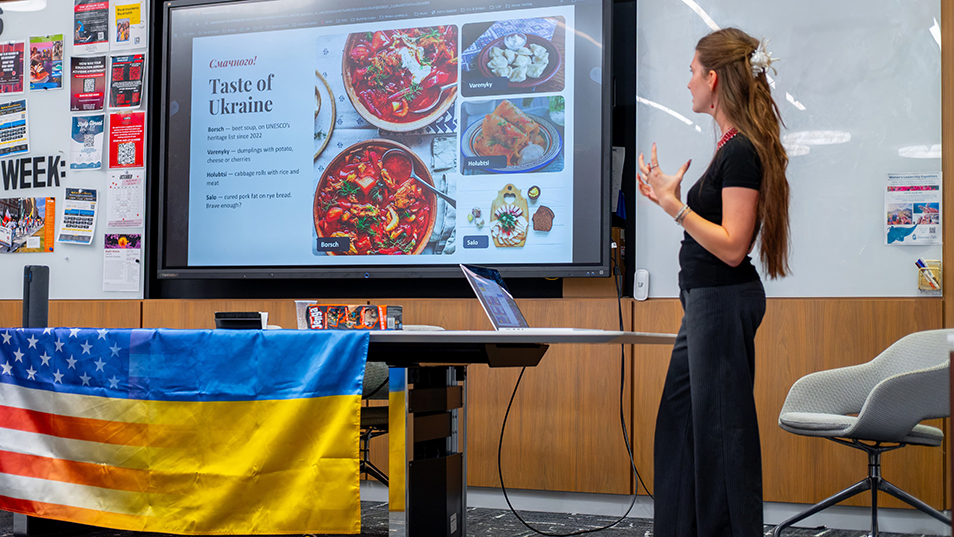
The group, which has about 17 members, held its first meeting last month, a potluck of Ukrainian food and a presentation on its culture, and plans more events in the coming weeks.
The goal is to educate American students about Ukraine and let Ukrainian diaspora students on campus, who may have family ties to the country, reconnect with their heritage. Morozova said the group also focuses on cross-cultural dialogue, learning about the world beyond the United States and dispelling stereotypes about Ukraine and Eastern Europe.
Showing people that the war is still going on, even when it isn’t making headlines, is crucial, she said.
“It not only affects Ukrainians, but it also affects the global community in general … because it impacts a lot of other things.”
Morozova grew up in Kramatorsk, a major industrial city in eastern Ukraine now close to the front line. When the war started, she fled to Poland, where some of her family still lives. She attended a UWC high school in Italy, where a visiting UTampa admissions counselor told her about the University.
She hopes to work in business in Europe after graduation and appreciates how professors connect classroom lessons to their industries.
“For example, my accounting teacher, he is not only teaching accounting; he also has his own business where he also works as an accountant, so you have this perspective of somebody who actually works in the field.”
The students are in frequent contact with relatives and friends in Ukraine and Europe. Morozova’s father and other relatives remain in Kyiv, the capital.
“Sometimes I receive questions if war is still going on, or it’s already finished, and for me, it’s such a shock when people say so. Like, ‘Oh, it’s already done.’ I’m like, ‘No, it’s not. It’s actually still going on,’” Morozova said.
Though neither student has returned to Ukraine since the war began, Morozova spent the summer in Europe visiting family. Natkha has not left the U.S. since arriving for school and spent the summer doing undergraduate research. Both hope to see family over the holidays but said they are excited and thankful for the opportunities and people they have found at UTampa.
The students hope the group helps others see the connections between the U.S. and Ukraine and appreciate how precarious freedom can be. Natkha said she worries that Americans, who live where “everything functions incredibly,” may take freedom for granted.
“Freedom is not something that’s given; it’s something that you fight for, and that’s something that you need to keep up with,” she said.
Learn more about Ukraine and other countries that are home to UTampa’s international students during International Education Week on campus from November 16-20. Events include a Flag Parade and Global Expo on Wednesday, Nov. 18, and a Cultural DIY Night on Thursday, Nov. 19.
International Education Week is a joint initiative of the U.S. State Department and the Department of Education that is held on campuses nationwide to celebrate the benefits of international education and exchange.