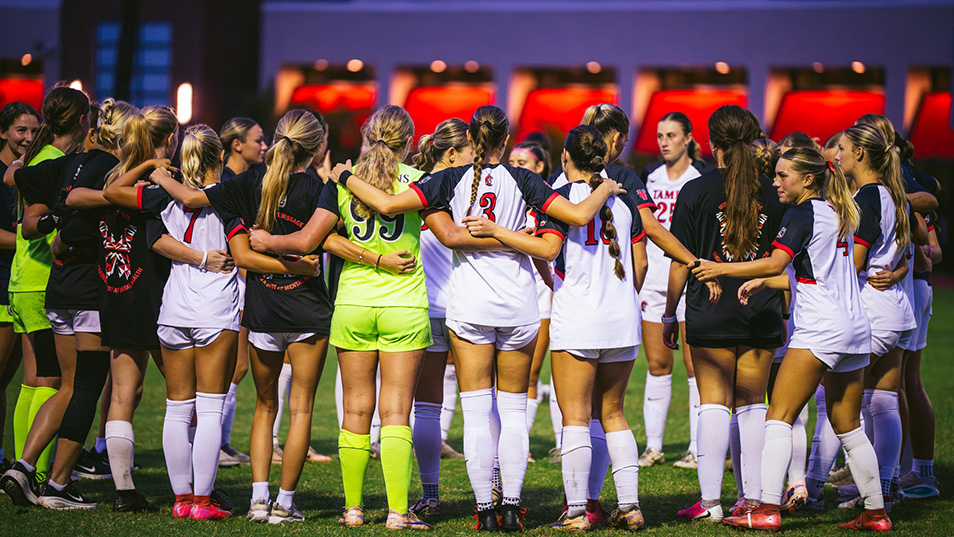
The UTampa women's soccer team hosted a Morgan's Message Dedication Game on Oct. 7. Photo courtesy of UTampa Athletics
It’s Okay Not to Be 100%: UTampa Athletes Take on Mental Health Stigma
Share

The UTampa women's soccer team hosted a Morgan's Message Dedication Game on Oct. 7. Photo courtesy of UTampa Athletics
When Juliette Vick ’23, M.Ed. ’24 rowed for the Spartans, she worried that some teammates might struggle with their mental health.
At the time, she felt that few campus resources addressed the distinct athlete experience, with no formal outlet for athletes to support athletes in the juggle of high-stakes games and rigorous practices with academics and social life.
“This is a huge issue,” she said.
When she saw a friend post on social media about Morgan’s Message, a national mental health awareness organization for collegiate athletes, she decided to start a chapter at UTampa.
That was in 2022. Four years later, UTampa is one of the largest chapters of Morgan’s Message in the country, with 27 student ambassadors representing nearly every NCAA team on campus and some club sports, including volleyball, lacrosse, soccer, basketball, track and field, ice hockey, swimming, tennis, rowing, field hockey, softball and golf.
Morgan’s Message provides training and mental health resources for its student ambassadors, and students lead and organize events, meetings and games that are dedicated to raising awareness and eliminating the stigma around mental health challenges in athletics.
The group’s focus: mental health deserves the same importance as physical health. A feature of the program is to unite athletes across individual sports to come together over the importance of mental wellness.
“It’s all student-driven, which is great,” said Vick, who now works in healthcare in New Jersey and still does work for the national Morgan’s Message organization. “We want it to be athlete to athlete.”
Helping athletes feel comfortable discussing their mental health remains a focus of Morgan’s Message and its awareness events at UTampa.
Darcy Highmore ’27, a sprint freestyler on the women’s swimming team, now spearheads Morgan’s Message at UTampa and has overseen “Dedication Games” from several teams this fall.
Highmore knows how important that is from her own experience. While living abroad at boarding school in England during the COVID pandemic, she was not able to see her family for long periods of time because of lockdowns and travel restrictions.
“It was something that took a toll on me, being away for so long,” she said. “I got really passionate about mental health so that people know it’s OK that you’re not 100%. It’s fine to open up and talk about it.”
Mental health is a real thing and a priority for UTampa athletics, said E.J. Brophy, vice president and director of athletics at the University.
“We fully support Morgan’s Message,” he said. “I’m all in because we want not only our students, not only our student-athletes, but everyone on our campus and beyond to be happy, to have peace mentally. If there’s any way we can draw attention to that, we want to do it.”
UTampa athletes raise awareness around Morgan’s Message and normalizing mental health chats with Dedication Games. Every sport with a Morgan’s Message ambassador has a Dedication Game this year, Highmore said.
Earlier this month, women’s soccer and volleyball hosted Dedication Games, with players wearing Morgan’s Message shirts during their warmups and reading a statement about the organization, committing their game to destigmatizing mental health.
The games are great ways to get the campus community involved in the mission of Morgan’s Message and also share it with the opposing team.
“It’s just a good way to spread awareness about everything,” Highmore said.
Nationally, Morgan’s Message continues to grow and has a presence overseas as well, said Haley Thomas, the group’s education program manager. It has 5,770 ambassadors on 1,856 campuses, including high schools and club teams, Thomas said.
Dedication Games are a highlight for teams and “provide an opportunity to remind athletes that their mental health matters just as much as their physical health and that their value extends far beyond their performance in their sport,” Thomas said.
Although conversations around mental health and the importance of wellness have become more common, that doesn’t always translate to athletes feeling more comfortable having them or asking for help, especially if they feel acknowledging they need help could jeopardize their athletic career.
“Even when resources are available, stigma and fear of judgment can prevent individuals from accessing the support they need,” she said.
Ultimately, Thomas said, seeking support is a sign of strength.