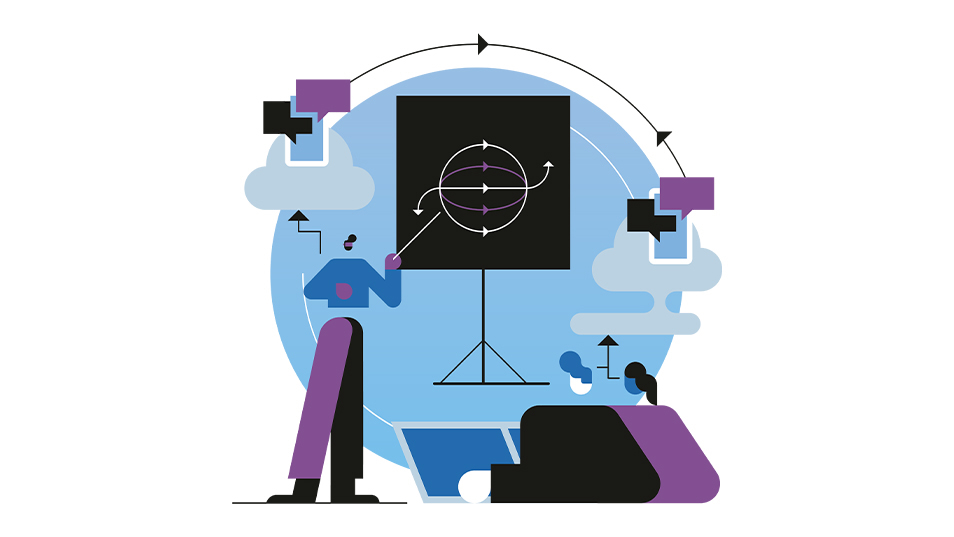
Illustration by blindSALIDA
Philosophy’s State of Being in the Age of AI
Share

Illustration by blindSALIDA
Can AI be conscious? What should be the ethical code for language learning models? Are robots a real threat to human civilization?
Tech companies are increasingly hiring employees with philosophy backgrounds to make sense out of such complicated questions. At UTampa, faculty prepare students to consider questions like these in their studies — with their eyes on longer-term career goals.
Marcus Arvan, chair and professor of philosophy and religion, studies AI safety and the question of whether large language model AI can safely align with human values. Torrance Fung, assistant professor of philosophy and religion, specializes in the philosophy of mind and the theory of knowledge, both of which are relevant to the concept of AI consciousness.
With a tool as powerful and pervasive as generative AI, Arvan said it gets tricky, as there are different models of moral psychology that intersect with behavioral neuroscience. Part of the philosophers’ jobs at tech firms, he said, is to know the different approaches the companies can take and to apply the best one.
“Anthropic embraces what’s known as a virtue ethics approach, trying to develop good character in its model, Claude,” said Arvan. “Whereas OpenAI is adopting a deontological approach that descends from the philosophy of Immanuel Kant.” (Deontological ethics places the moral emphasis on an action or duty, rather than on the outcome of said action or duty.)
Another aspect of AI philosophers’ job descriptions is to explore the possibility of consciousness. Fung said there are different definitions of consciousness to consider. One of them means possessing a concept of self — for example, a bathing bird can see its reflection in the water and recognize it as itself. Another is access consciousness, meaning a person or thing can process information to navigate the environment, such as how the Mars rover does.
In the Classroom
Fung is teaching an Ethics and Artificial Intelligence course in the philosophy department this semester, where students discuss the exact questions that professionals in their field are getting hired to address in Silicon Valley. The class counts as an elective for the minors in AI and AI Applications.
One of the topics covered in the course is algorithmic bias. Recently, the class looked at a case study of a family applying for a loan at a bank, which uses an algorithm to evaluate if the family is fit to pay the loan back in time. If the algorithm was coded with an implicit bias, it could deny the loan based on irrelevant factors like the family’s race. The students then investigated who should be held accountable in situations like these.
Fung said the same goes for self-driving cars when asking who is to blame for accidents. He said the class examined several variations of the trolley problem — a classic philosophical dilemma weighing the ethics of sacrificing one person to save a larger group of people — to figure out how to program the cars to make the best decisions. The group then went beyond that, wondering who should decide how the programs are designed.
“Should self-driving cars try to save as many lives as possible, or prefer saving certain types of lives, like children, more than others?” pondered Arvan, the original creator of the course.
The course aims to cover topics that are relevant and interesting to students; Tampa is one of the most recent cities to officially launch Waymo’s self-driving ride-hail service. Students are asked to argue both for and against applications of artificial intelligence.
“That’s one of the main skills I want to teach them in a philosophy class: how to give justification for your view as well as justification against that view,” said Fung.
Arvan said he significantly updated the material covered in Ethics and Artificial Intelligence after ChatGPT debuted in late 2022, followed by competing large language models. Another course in the philosophy department, Minds, Brains and Metaphysics, also counts as an elective for the two AI-related minors.
A Nimble Approach
Artificial intelligence has long been a hot topic in the field of philosophy, and study of it has required keeping up with the technology’s development. Indeed, both his and Fung’s understandings and beliefs about the technology have evolved over time.
Arvan said he didn’t expect that AI would get to where it is today. The common narrative in his early work was that AI might be able to reason logically, but it wouldn’t be able to create anything with emotion, like art or music.
“It turns out that those are the easiest things to get it to do,” said Arvan. “They can make beautiful-looking works of art or musical compositions, but what they really struggle with is distinguishing what’s true from untrue and being able to reason in ways that don’t go astray.”
As for Fung, his position on AI and self-consciousness has changed. “I used to think there was no way,” he said.
He uses the famous thought experiment of John Searle’s Chinese Room to express the conflicting opinions in the field. The example demonstrates that if a person who doesn’t speak Chinese runs a computer program to communicate with someone who’s fluent, it does not mean they understand Chinese. The same idea can be applied to AI consciousness: running a program will never suffice for consciousness.
However, Fung suggests that humans run programs in their heads whenever they follow a list of instructions. He argues that it’s arbitrary to believe a human brain running programs equals consciousness, while a computer “brain” running the same exact programs does not.
“So, if you think the laws of nature are not so arbitrary, you might think robots could be conscious someday,” said Fung.
Philosophy in the Field
Arvan cites data reporting that in 2026, philosophy grads are more likely to have jobs than computer science majors. A recent CNBC report also states that philosophy majors are among those that outperform STEM-based majors in terms of employment prospects.
Still, the philosophy faculty at UTampa encourage students to double major, leading them to a wide swath of career applications, no doubt where AI also comes into play.
“We did a self-study a few years ago looking at where UTampa philosophy grads have gone into work,” said Arvan. “They’ve gone into corporate recruiting, cybersecurity, data governance, finance, health, human resources, insurance, law, marketing, behavioral and physical therapy, real estate and public policy.”
An undergraduate degree in philosophy challenges a person to think carefully and clearly about this entire array of issues in a way that no other undergraduate major does. UTampa's philosophy department is designed to endure fluctuations of the age of AI, though the answers to the most salient questions about modern technology remain elusive.