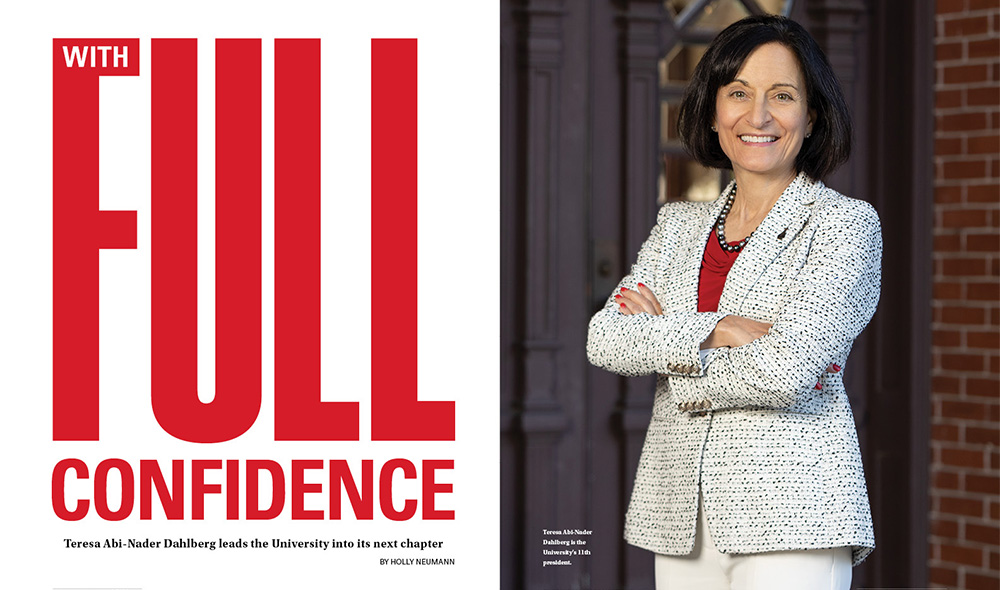
Teresa Abi-Nader Dahlberg is the University’s 11th president. Photo by Alex McKnight
With Full Confidence
Share

Teresa Abi-Nader Dahlberg is the University’s 11th president. Photo by Alex McKnight
A DIFFERENCE-MAKER
President Dahlberg was a candidate for a permanent assistant professor position at Winthrop when UNC Charlotte was expanding its electrical engineering offerings. It was a right-time, right-place moment for Dahlberg, who applied and was hired as an assistant professor.
“My goal was to achieve tenure and then full professor,” Dahlberg said, and she did. Her research and advocacy along the way was in computer science education and broadening the demographics of people who work in computing. She wrote and received grants, becoming a top-funded researcher at Charlotte, and co-founded and led the Stars Computing Corps, a National Science Foundation alliance still operating today that aims to strengthen the computing student pipeline through community engagement. Undergraduates partner with business and nonprofit professionals to do outreach within K-12 schools. As director, she worked with more than 50 colleges and universities nationally, over eight years, including FSU, FAMU and Florida Polytechnic (then called USF Lakeland) — schools that were founding partners.
Dahlberg cites the book A Hope in the Unseen by Ron Suskind for influencing and changing the way she thinks and sees the world. It’s the true story of Cedric Jennings, a Black boy in Washington, D.C., who grows up in poverty, and the isolation he faces and the growth he achieves as he navigates college at an Ivy League university.
“I probably read it 20 years ago,” Dahlberg said, “and it made me realize that our chances for being successful can largely depend on what we’re exposed to or not exposed to. … It’s the most impactful book I’ve ever read.”
Dahlberg began to notice that many of the real difference-makers in higher education were often in administration, where decisions could be made, and she wanted to make lasting change. When the associate dean position opened in Charlotte’s College of Computing and Informatics, she went for it and was appointed.
Dahlberg stayed 18 years at Charlotte, rising from assistant professor to associate dean, followed by two deanships — dean of the Nerken School of Engineering at The Cooper Union in New York City and dean of the College of Engineering and Computer Science at Syracuse University.
She made a name for herself. She held a seat on a National Science Foundation advisory board and co-chaired the education workforce subcommittee. She was “always pushing to get the university visibility, as well as to influence education at the national level,” she said. Opportunities started to come her way.
In 2019, she joined Texas Christian University in Fort Worth as provost and vice chancellor for academic affairs. She oversaw nine schools and colleges, along with campus research, faculty affairs, enrollment, international studies and more, and she led the establishment of TCU’s Burnett School of Medicine, including securing a $50 million naming gift.
INTEREST MEETS ASPIRATION
“It wasn’t until I was a provost that I thought about being a university president,” Dahlberg said, and when the UTampa position was announced, it was another right-time, right-place moment for her. Her contributions to TCU were substantial. She was open to considering a next step.
UTampa offered some things most other university president jobs didn’t: stable university finances plus strength in numbers. This piqued her interest.
“Dr. Vaughn had been on the job for almost 30 years, and student enrollment had continuously increased throughout his tenure. I thought, ‘This is not typical. … This is a very healthy university. It’s an aspirational university. It’s in a growing city. That’s something I want to look into.’”
She was impressed by the University’s growth in prominence and infrastructure, as well, and quoting Vaughn, she said, “its culture of striving for continuous improvement.”
She sees it as “growth in excellence,” infinite in possibilities.
THE LISTENING TOUR
Dahlberg started meeting students, staff and faculty last summer. She finds it a compliment when people remark upon meeting her that they didn’t imagine her being as short as she is. (She’s 5 feet tall.) People have told her that when she walks into a room, she “fills it up.”
In her first week at UTampa last June, she announced a presidential transition advisory committee of campus stakeholders and key players, the first step on her listening tour.
What’s nice, she said, is that she’s not coming in to solve specific problems. Still, she acknowledges that she’s probably experiencing a “honeymoon period” of mostly smiles and few complaints.
“I think my best skill set is listening and making connections between different people and programs and different points of view and aspirations,” she said. “I ask a lot of questions. It might take a while, but then common ideas start to come up.”
Dahlberg is eager to hear and develop ideas for how the University can distinguish itself, so when outsiders see or hear of the University of Tampa, they already know what makes it great, no research required. She said that the Spartan Ready curriculum (the “fabulous” academic, career- and life-readiness and social mobility skills all UTampa students learn) is one of many opportunities for the University to stand out to the community and to prospective students.
Dahlberg calls herself a first-year student as she leans into the University community, so she shares an empathetic bond with every Spartan and has some advice specifically for her fellow first-years.
“Go to class. Do your homework. Meet your teachers in their office hours…. But also have fun, and don’t worry about how nervous or awkward you might feel because everybody else is feeling that way, too.”
Dahlberg herself is holding meetings, collaborating, flexing her study muscles. She just finished reading three history books about the University of Tampa.
And she’s ready to add another chapter.