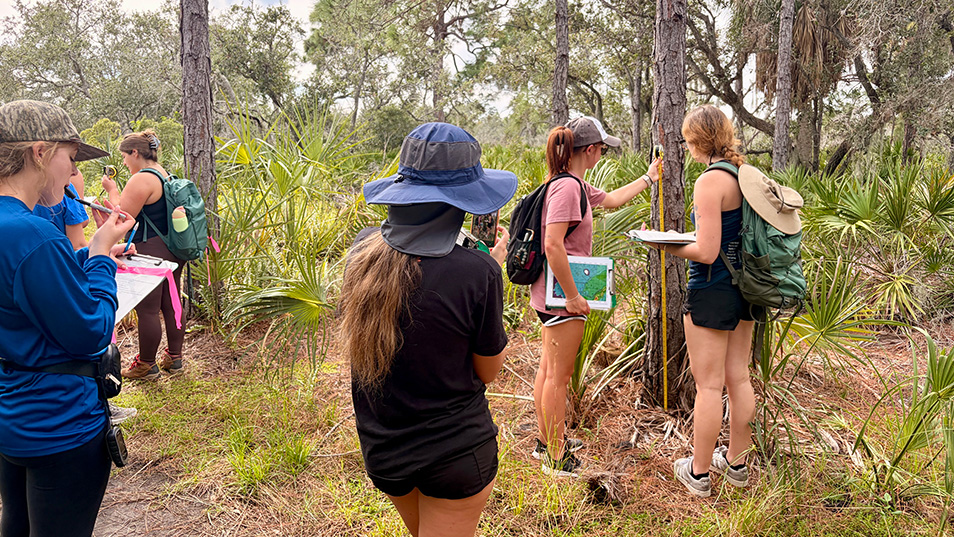
Part of the students' practicum exam included measuring and marking the estimated storm surge from Hurricane Helene. Photo by Madeline McMahon M.A. '24
Wetlands Course Offers Students Realistic Field Experience
Share

Part of the students' practicum exam included measuring and marking the estimated storm surge from Hurricane Helene. Photo by Madeline McMahon M.A. '24
In UTampa’s Water, Wetlands and Wildlife course, students had an exam on Tuesday, but not one that could be completed in a classroom with pen and paper or a laptop. Instead, the students’ required equipment was bug spray, sunscreen and clothes that could get muddy, and the classroom was Weedon Island Preserve across the bay from campus.
The environmental studies course, taught by Assistant Professor Kendal Jackson, takes students into the field every week to examine the natural environment. Among the palms, pines, moss and mangroves at Weedon, the students’ practicum exam for the coastal wetlands unit included identifying plant species using a coastal vegetation guide and estimating how high the storm surge was in the park during Hurricane Helene in 2024 using topographic maps that measure the area’s elevation.
Split into teams, the students logged native plants like midsorus ferns, goldenrods, flatsedges and colicwoods, then used tape measures and pink flagging tape to mark tree trunks for how high the flooding was during Helene. After the technical work was completed, the post-exam reward was an off-trail hike through ankle-deep mud and the waist-deep estuary. During the hike, Jackson used a sediment corer to take a sample of peat from the ground and explained that the organic plant matter stores tons of carbon underground, keeping it out of the atmosphere where it would warm the planet.
It was the muckiest field trip so far in the semester, but the students have been continually improving their preparation for spending an afternoon facing the natural elements. Natalie Price ’27 had to fully submerge her white tennis shoes in the earth; it seemed like the end of life for the pair of Nikes, until she said that the same thing happened last class, and she was able to restore them with Dawn dish soap and a washing machine cycle. Jackie Sibila ’27 brought an extra pair of shoes to change into before immediately heading to her next class.
“(A lot) of the effort of the class is to give them a realistic sense of what it’s like to work as a field scientist,” said Jackson. “Most field science has a fair amount of outdoor manual labor, and it’s important to have all these skills that you don’t learn in a classroom.”
Miranda Bowling ’27, a marine science-biology major with a minor in sustainability, values the opportunity to break the routine of being in a classroom all day. Her other classes in marine geology and marine botany have occasional days going outside to collect samples, but the Water, Wetlands and Wildlife class has by far the most outings in a semester that she’s experienced.
The students, all upperclassmen, hold a variety of majors and minors in the College of Natural and Health Sciences. Jackson designed the class to emphasize transferrable skills for field research rather than lessons specific to wetland studies. For example, the class can set up students to pursue careers in a government agency managing water resources or consulting for an engineering firm.
“If you get into that world, one of the major jobs is what we call wetland delineation,” said Jackson.
Wetland delineation can mean blocking off certain areas in a community to preserve the native flora and fauna, or it could be classifying open land as being safe for new development or not.
The class saw a real-life example a few weeks agao of development over a wetland area and how it can affect that area over time. They walked from campus to the Historic Hyde Park neighborhood to follow the trail of an old creek that was closed off and rerouted to the bay in order to build houses; the creek was later artificially filled, but it still affects the area more than 100 years later.
“The drainage is still there,” said Jackson. “That area now has the worst flooding in Tampa. … It’s a really good lesson of how you can put this river in a concrete box, but it doesn’t solve all the problems.”
It was raining the day they walked to Hyde Park, so students saw the stormwater drainage system in action as they followed the path of the ghost creek.
“Another industry they could enter with this class’s training is stormwater management,” said Jackson. “If you work for any kind of local government, or even if you want to be an entrepreneur, at some point you’re going to have to deal with water management.”
For some students, the class gives them an idea of what they don’t want in a career and helps narrow down their options. “It’s interesting, but I’d prefer it’d be interesting from behind a desk,” remarked one of them. But for now, they appreciate the chance to get outside and, literally, touch grass.