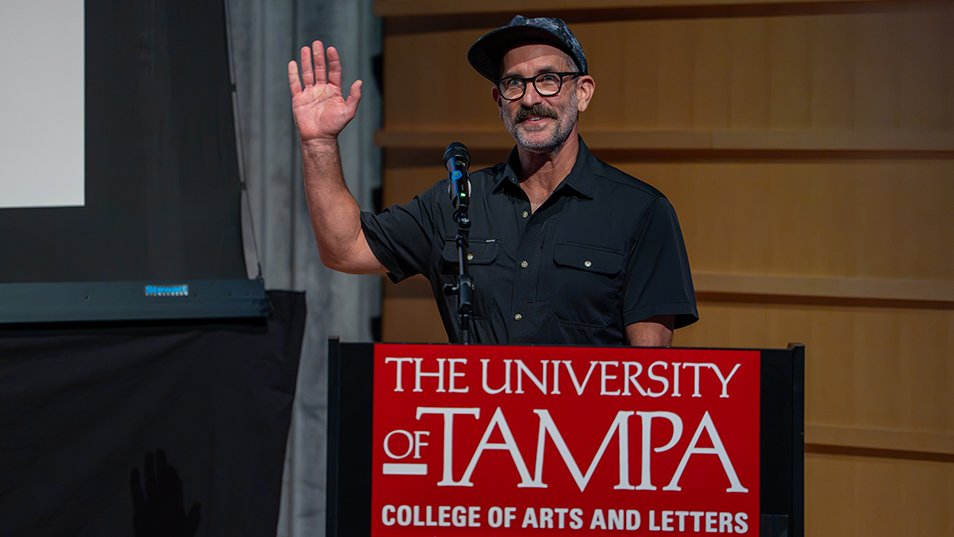
Brad Schiff '93, head of animation at LAIKA Studios, returned to campus last week. Photo by Jacob Cochran
Tampa Animation Festival Welcomes Home Oscar-nominated Alumnus
Share

Brad Schiff '93, head of animation at LAIKA Studios, returned to campus last week. Photo by Jacob Cochran
When Brad Schiff ’93 transferred to University of Tampa in 1990 to pursue animated filmmaking, he was placed in a 22-person waitlist for the introductory animation course.
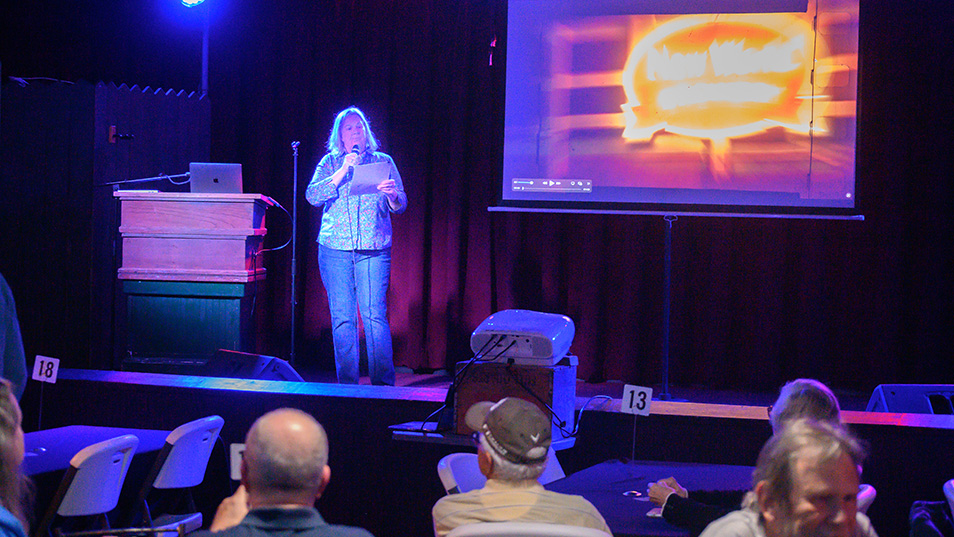
Last week, he returned to campus as an Oscar-nominated artist and head of animation at LAIKA Studios, presenting three feature films by the studio at the third annual Tampa Animation Festival, which ran from Nov. 5-8.
Along with LAIKA’s Wildwood, ParaNorman and Kubo and the Two Strings (for which Schiff was nominated in the visual effects category of the Academy Awards in 2017), the Tampa Animation Festival played a total of 119 animated pictures, with every continent except Antarctica represented in the lineup. On Sunday, awards were announced in 11 categories; the overall winner for narrative animation was Beyond Measure, a hand-drawn short by Australian cartoonist David Ferrier.
Before the festival opened, Schiff gave a masterclass to students in the Department of Film, Animation and New Media (FMX) on Wednesday, sharing an inside look into how some of the students’ favorite stop-motion films were made, such as Coraline and Fantastic Mr. Fox.
The behind-the-scenes insight continued Thursday and Friday, when Schiff held audience Q&As after the screening of LAIKA’s newest film, Wildwood, and before ParaNorman.
Wildwood made history when it released in October as the longest-running stop-motion animated film of all time. Amid the award season buzz, the Thursday screening on campus sold out 10 minutes after ticket reservations went live, said Gregg Perkins, FMX professor and director of the festival.
The fantasy epic garnered many “oohs” and “aahs,” but the audience was even more wowed to learn the details behind the animation team’s painstaking efforts put into the movie over the last 16 years. The biggest gasps came when Schiff broke down the pace of production and the logistics of the puppets. He said that a good day on set would mean 25 frames were shot — which adds up to a single second of animation. Particularly intricate scenes might only capture eight frames a day, or one-third of a second.
The main character in Wildwood, Prue, goes through a complex emotional journey as she tries to save her baby brother from an enchanted forest, while discovering a hidden truth about herself. Her inner thoughts are conveyed through many facial expressions, leading the audience to wonder how this could possibly be executed in a puppet. Schiff explained that every expression worn by Prue or the other characters was made of bespoke 3D-printed face plates that were switched out for almost every frame.
Audience members expressed awe and curiosity about the entire production. FMX alum Aiyanah Esparza ’25 was impressed with the diversity of the characters and their detailed, textured hair; Steve Ifantis ’26, film student and technical director for the festival, wondered how LAIKA has adapted to new technology since the studio debuted with Coraline in 2009; Paul de Lumen, assistant professor and professional cinematographer, commended the cinematic quality and asked how the director of photography, Caleb Mitchell, got involved.
Later, an audience member asked Schiff to recount how he got his start in stop-motion animation at the University of Tampa. With a smile, Schiff recalled that 22-person wait list.
He was a freshman Central Missouri State University, and on Thanksgiving break, his best friend, Mason Rothert ’92, showed him a short film he had made in his first semester at UTampa. Schiff said he had been feeling listless in Missouri, so he decided to follow Rothert to Tampa, hoping to collaborate on Claymation projects.
Once a Spartan, Schiff needed an introductory animation course, which was a requirement for all other animation classes. He was late in registering, though — hence the wait list — so he leaned on a little help from his friend.
Rothert had been working closely with the animation department’s founder, Richard Protovin, on his own short films and was confident that Schiff could get an independent study with the professor. (Protovin also founded the animation department at New York University in 1979 before moving back to Tampa in 1988, where he had attended Boca Ciega High School and University of South Florida.)
The students showed Protovin a clay head that Schiff had sculpted the night before, and Protovin saw promise in the young artist. He granted him the independent study, as well as priority placement in the introductory animation course.
“Richard saw something in that stupid clay head,” said Schiff. “It was as if someone grabbed me by the shoulders and said, ‘keep walking that way.’ I’ve dedicated my whole career to pushing what’s possible in stop motion animation, and it all started with Richard Protovin.”